
Moving a cast iron radiator is often the first step in a renovation that turns into a puzzle. Between the weight of raw cast iron, the water trapped in the pipes, and the number of elements that varies from one model to another, a rough estimate is not enough. Understanding how this weight breaks down allows you to anticipate the right number of hands, check the strength of a floor, or simply organize transportation without unpleasant surprises.
Empty weight of a cast iron element: how the number of columns changes things
Have you ever lifted a single cast iron radiator element? Even when isolated, it is heavy. The mass directly depends on the number of columns per element and the height between axes.
An element with 2 columns contains less metal than an element with 4 or 6 columns, which seems obvious. What is less obvious is the actual difference: at the same height, a 4-column element can weigh almost double that of a 2-column element. On a radiator with ten elements, the difference can be measured in dozens of kilos.
To estimate the total empty weight, the most reliable method is to multiply the weight of one element by the number of elements. Manufacturers’ technical data sheets systematically indicate this information by model. Without a data sheet, counting the elements (the visible vertical sections) and referring to the tables from the original manufacturer remains the only serious approach.
Before any handling, it is useful to know how to calculate the weight of a cast iron radiator to adapt the handling equipment to the specific case of your installation.
Water capacity per element: the variable that everyone forgets
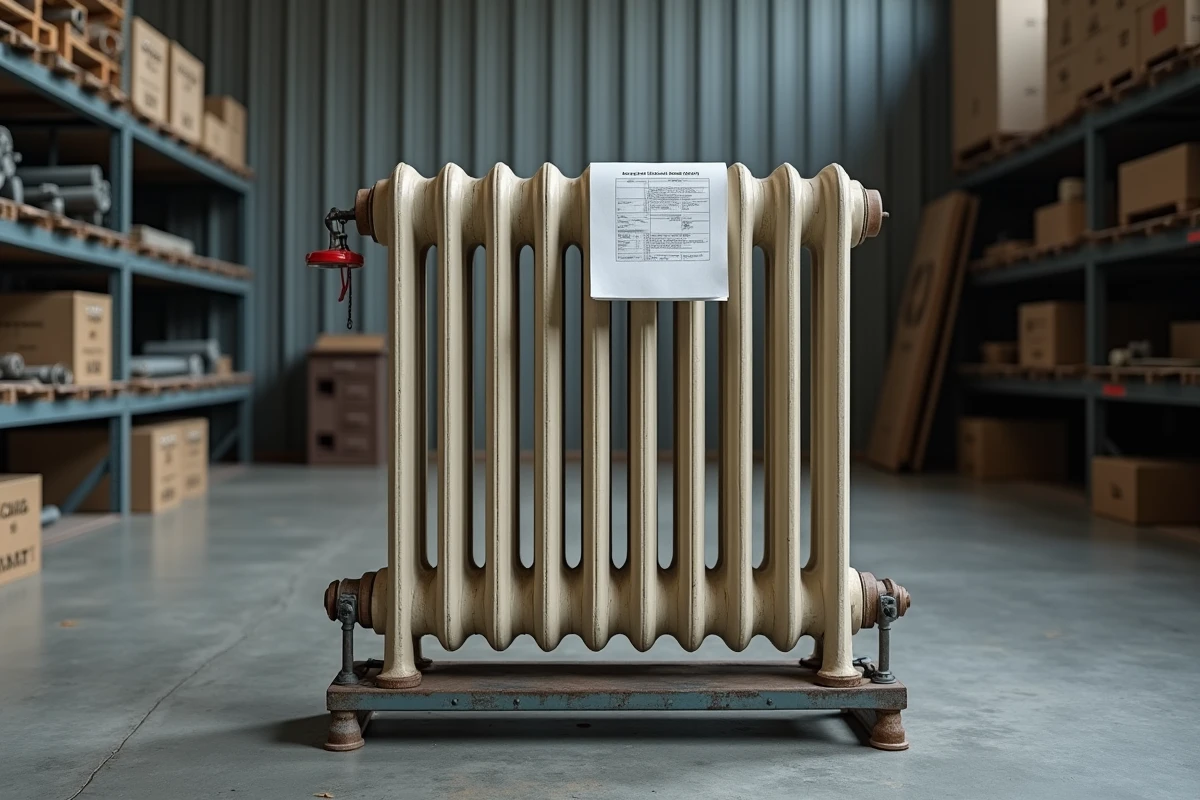
A cast iron radiator connected to the heating circuit is never empty. The water circulating inside adds significant mass, and this mass depends on the internal volume of each element.
The manufacturers’ data sheets specify the water capacity per element, expressed in liters. Since the density of water at domestic operating temperature is around 1 kg per liter, the calculation is straightforward: each liter of water adds about a kilogram.
Let’s take a concrete example. A radiator with 12 elements and 4 columns, each containing a certain volume of water, will see its total weight in operation exceed the empty weight significantly. On large old models (6 columns, significant height), the water can represent a quarter to a third of the total operating weight.
Complete calculation formula
The formula can be summarized in one line:
Total weight = (weight of one element × number of elements) + (water capacity per element × number of elements)
This formula works for all hot water models, whether they are old radiators or new models. The output unit is kilograms.
- Identify the exact model (brand, number of columns, height between axes) to find the corresponding technical data sheet.
- Count the number of elements on the front: each vertical section separated by a joint constitutes one element.
- Record the unit weight when empty and the water capacity per element from the manufacturer’s documentation.
- Apply the above formula to obtain the weight in operation, then the empty weight if the radiator is drained.
Electric cast iron radiator: a different calculation
Are you considering replacing an old water radiator with a cast iron model with electric inertia? The reasoning changes completely. These modern devices incorporate a heating element embedded in a block of cast iron optimized for thermal inertia, but they do not contain water.
The weight displayed on the technical data sheet corresponds to the actual weight in operation. No water capacity to add, no draining to anticipate. Common models weigh between several dozen and over a hundred kilos depending on size, with a significant mass of cast iron per element.
The confusion between the two types (hot water and electric) leads to errors in sizing wall mounts. An electric cast iron radiator is mounted on the wall with brackets suited to its actual weight, while a hot water radiator must be mounted to support the weight in operation, including water.

Check the load-bearing capacity of the floor and fixings
Knowing the weight of a cast iron radiator is not only useful for organizing a move. A large radiator in operation can exceed 200 kg on some older models with many elements. This weight is concentrated on a small floor area, often two feet or two wall brackets.
Before reinstalling a cast iron radiator after renovation, two checks are essential:
- The strength of the floor: an old wooden floor may flex under a heavy radiator, especially if the joists are spaced or weakened by moisture.
- The resistance of the wall fixings: the brackets must be sized for the total weight in operation (cast iron + water), not just for the empty weight.
- The distribution of the load: cast iron radiator feet allow part of the weight to be transferred to the floor, relieving the wall fixings.
Special case of upper floors and lightweight partitions
On an upper floor or a plasterboard partition, installing a cast iron radiator requires structural reinforcement. Battens or a distribution plate screwed into the load-bearing studs prevent the fixings from pulling out.
The weight of a cast iron radiator with water remains a technical data point that conditions both the choice of supports, the feasibility of installation on an upper floor, and the number of people needed for handling. Retrieving the technical data sheet for the exact model, counting the elements, and applying the formula remain the three steps that separate a rough estimate from a reliable calculation.